
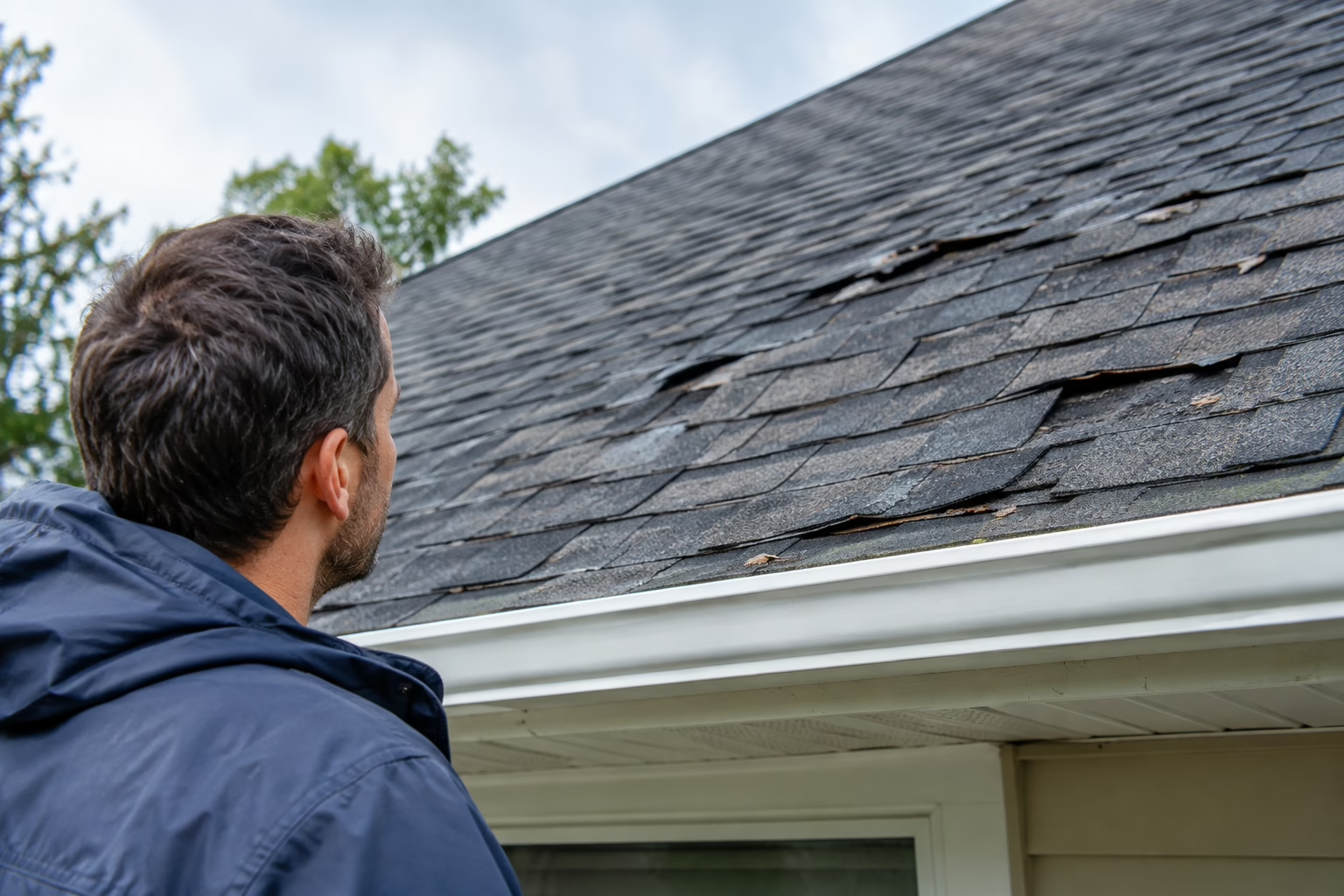

Most storm damage never shows up as a hole in the ceiling. It shows up as a cracked sealant bead, a shingle whose adhesive strip let go, or a quarter-sized bruise you can feel but barely see, and those small failures leak quietly for months before anyone notices. The 5 signs your roof has hidden storm damage below are the ones experienced inspectors look for first, and most of them can be spotted from the ground or the attic.
1. Granules Collecting in Gutters, Downspouts and Splash Blocks
Asphalt shingles shed a few granules naturally, especially in the first year after installation, so a light dusting is normal. What is not normal is a half cup of coarse black sand sitting in a downspout elbow or piled against a splash block within days of a hailstorm.
Those granules are the shingle’s sunscreen. Once hail knocks them loose, the exposed asphalt oxidizes under Georgia summer sun and can lose several years of service life well ahead of schedule.
- Check the bottom of each downspout and the gutter troughs after any storm with pea-sized or larger hail.
- Look for shiny dark spots on the shingle surface, which indicate bare asphalt where the granule layer is gone.
- Note whether the granule loss is concentrated on one slope, a common sign of directional hail rather than normal aging.
2. Shingles That Look Lifted, Creased or Slightly Out of Line
Missing shingles are obvious from the driveway. The expensive problem is the shingle that is still there but no longer sealed, because wind flexed it hard enough to break the adhesive strip and leave a crease across the face.
A broken seal means that shingle will flutter in the next 30 mph breeze and let wind-driven rain run underneath it. From the ground, scan the roof edges and ridges with binoculars and look for rows that read as wavy rather than straight, or shingle tabs that cast a thin shadow line where they should lie flat.
Rakes, ridges and hips take the worst of it. If you also see missing ridge cap pieces or exposed nail heads along the ridge, water has a direct path into the decking.
3. Soft Bruises and Dents on Metal Components
Hail rarely punches through a shingle. It crushes the mat underneath, leaving a bruise that feels soft and slightly spongy when you press it with a thumb, similar to a bruised apple. That bruise cracks the fiberglass mat and the shingle fails two or three seasons later, long after the storm date most insurers care about.
Because bruises are hard to see from the ground, check the soft metals first. Research from the Insurance Institute for Business & Home Safety has shown that hail impact energy strong enough to dent aluminum and fascia is usually strong enough to damage asphalt shingles on the same slope.
- Dings in gutter faces, drip edge and aluminum fascia wrap
- Dents on turtle vents, ridge vents, pipe boot caps and chimney caps
- Bent fins on the outdoor air conditioning unit, a reliable hail witness mark
- Fresh pockmarks on a wood deck rail, mailbox or grill lid
Our walkthrough on how to inspect a roof for hail damage covers the chalk-square method adjusters use to count impacts per 10-by-10 test area.
4. Cracked Sealant and Shifted Flashing Around Penetrations
Roughly three out of four leaks start at a penetration rather than in the open field of shingles. Chimneys, skylights, valleys, plumbing stacks and wall-to-roof transitions all depend on flashing and sealant that storms love to pry at.
After a high-wind event, look for step flashing that has pulled away from the chimney mortar, counterflashing with a gap you can slide a credit card into, or a pipe boot with a split rubber collar. Sealant beads that have cracked or pulled into a thin dry ribbon are no longer waterproof, even though they still look like a repair.
These are small fixes caught early and major interior repairs caught late, which is why a storm damage roofing company in Cumming, GA starts every inspection at the penetrations instead of the field shingles.
5. Faint Ceiling Stains, Attic Moisture and a Musty Smell
Interior clues usually arrive last, which is exactly why they matter. A tea-colored ring on drywall that measures two inches across today was active water weeks ago, and the decking above it has likely been damp through several wet and dry cycles.
Go into the attic on a bright afternoon with the lights off and a flashlight in hand. Pinpoints of daylight at the ridge or around a vent mean the deck is compromised, and dark streaking down the rafters tells you where the water has been traveling.
- Stains on the underside of the decking, especially rings with defined edges
- Insulation that is matted, discolored or damp to the touch
- Rusted nail shanks or frost-like deposits on nail tips in winter
- A persistent musty odor near one end of the attic
What to Do in the First 72 Hours
Documentation is worth more than speed here, though both help. Photograph the damage with a timestamp, keep the date of the storm handy, and save receipts for any temporary tarping you pay for, since most policies reimburse reasonable emergency mitigation.
Then call a local roofer for a documented inspection before you file. Our guide on what to do after storm damage to your home walks through the claim sequence in order, and it is worth reading before you agree to anything.
One caution for 2026: after every large hail event in North Georgia, out-of-state crews work the neighborhoods for a few weeks and disappear. Here is the difference between storm chasers and established roofing companies, including the questions that separate the two in about 90 seconds.
Schedule a Storm Damage Roof Inspection
If you spotted any of these signs after recent weather, have the roof documented while the storm date is still fresh and the evidence is still on the shingles. Call Award Roofing to set up an inspection, and we will give you photos, a written assessment and a straight answer on whether a claim is worth filing.